
What inspired you to write Creek Crawling? Was there a particular childhood memory, experience in nature, or little creature that sparked the idea?
I am a child of the 1980s, when life consisted of us kids occupying ourselves outside for hours at a time. I also happened to grow up in a small, swampy town in north central Florida where creeks are plentiful. So, creek crawling was an integral part of almost everyone’s childhood where I lived. I recall my older brother coming home with shark’s teeth and fossils, and I joined the fun as soon as I was able. My mother spearheaded our outdoor adventures, and my father, a forestry professor and environmental scientist at the time, was right there too. It wasn’t until I became an adult and moved away from Florida that I realized how special it is to go creek crawling.
Then, in 2020, during the pandemic, my kids and I were going stir-crazy. That’s when I spoke with one of my friends back home who invited us to her property for a creek crawl. We drove over, met outside on a glorious spring day, and explored Hogtown Creek. It was healing on so many levels. I still have the pictures I took that day as inspiration for this book.
Creek beds are full of tiny discoveries. What do you hope young readers notice, appreciate, or become curious about when they join this adventure?
With the internet at our fingertips, I think it’s easy to forget what it feels like to do the exploring and discovering for ourselves instead of through a screen. I hope young readers are reminded that wonder can be found anywhere—even outside their door—if they’re open to it.
When you were writing Creek Crawling, how did you bring the sights, sounds, and discoveries of a creek to life on the page? Was there anything particularly challenging about writing this story?
A creek crawl is about the journey, not just the tactile moment of finding a fossil. In fact, many times fossils aren’t found, but you never come back empty handed after a new experience. That experience—the actual feeling of walking through a forest and what it’s like to hear, see, and smell a wild space after a summer storm—is what I hoped to share with the reader. To do this, I relied a lot on sensory moments, like the swishing sounds of grass, the heaviness of summer heat, or the audible drip of rain from a leaf.
A creek crawling adventure can be had anywhere, but these are the things I most associate with a good creek crawl.
Nicole Wong’s illustrations help bring your story to life. What was your reaction when you first saw her artwork? Did she capture anything about the story that surprised you?
When I first saw Nicole’s sketches for Creek Crawling, my only comment was “It’s perfect!” I love her take on the mother and child and all of the personal touches that she’s brought to this book. Nicole was able to capture the story in a way far beyond what I initially imagined. Each page turn is a breathtaking discovery of color and delight.
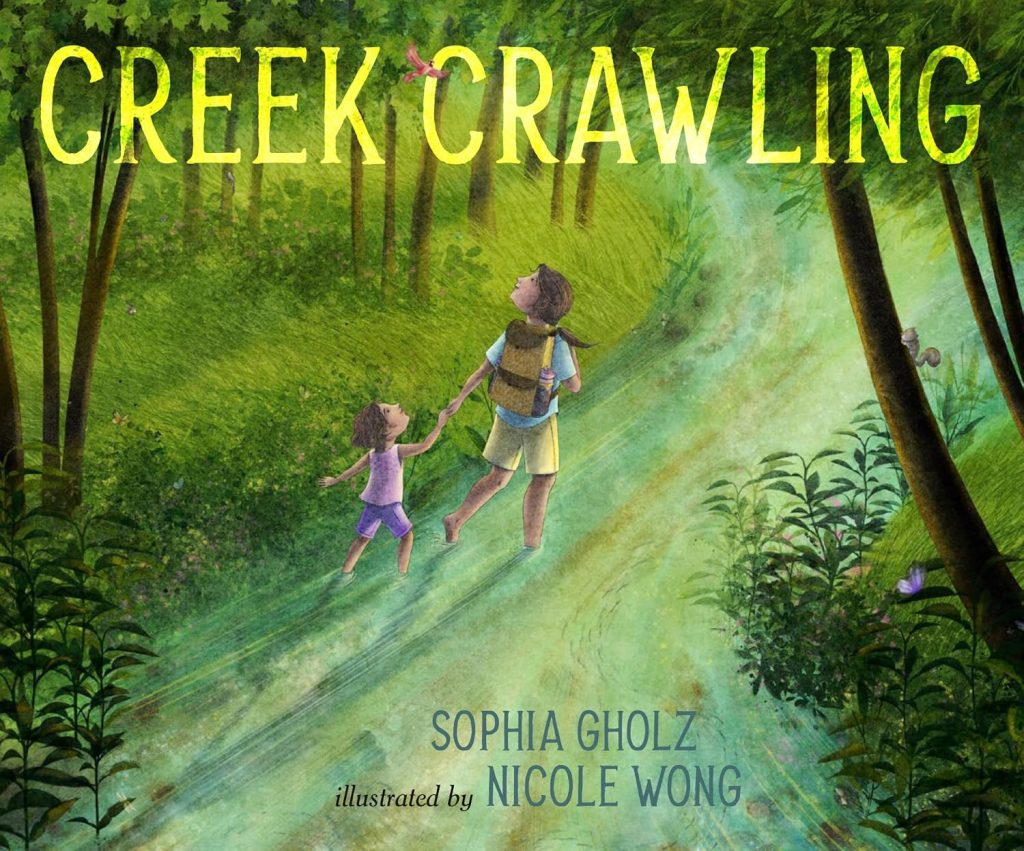
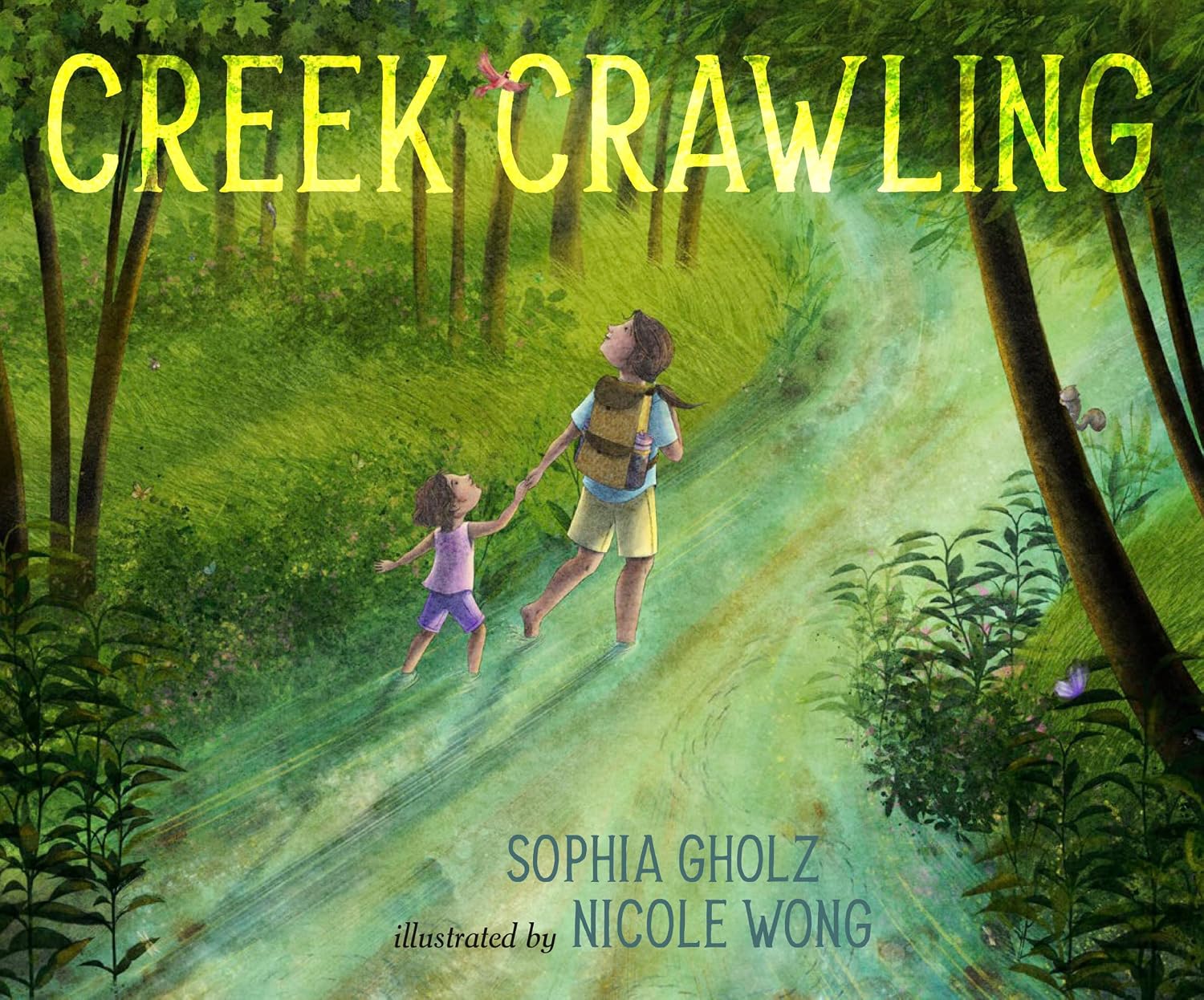
Of all the illustrations, I think I was most surprised by the cover. Nicole managed to encapsulate the entire essence of this story in one image, down to the subtle details like a lone bird and a hidden butterfly. What I love most, though, is how she hints at an adventure that feels both incredibly grand and quietly special at the same time.
I am in love with this art and feel very lucky to have worked with Nicole Wong on this story.
What are some of the interesting things children might discover about creek ecosystems, wildlife, and the importance of protecting these natural spaces through this book?
Growing up in Florida, it is ingrained in our minds that alligators are everywhere. If there’s freshwater, there’s a gator. Period. Still, I am always surprised to see a creek gator. With so many other bodies of water available, creeks seem like a less appealing place for a gator. But they are there, and it’s a good reminder that these are wild spaces that don’t belong to us.
When we walk into a natural habitat, we’re entering the home of the animals and insects that live there. We are the guests and, as such, it’s important to have good manners. If we don’t, then we risk ruining and losing these spaces for them and for us.
There will be no fossils but our own to find if we don’t care for the world around us. So, it’s important that we remember to leave any environment either untouched or improved after we visit it.
If you could send kids off on their next outdoor adventure with one piece of advice, what would you tell them? What do you hope they take away from reading Creek Crawling?
The world can be a complicated place. If it ever feels like it’s too much, nature will always welcome you. Watch the clouds, stick your toes in the dirt, pause to breathe with the earth. If you look for magic in everything, you will find it.